
| ||
| The Ovation Fan Club | ||
| ||
| Random quote: "I've always felt that blues, rock 'n' roll and country are just about a beat apart."-Waylon Jennings |
 Memory loss, info on Adamas tag Memory loss, info on Adamas tag
| View previous thread :: View next thread | |
| Members Forums -> General Posting | Message format | |
Todd G. |
| ||
Joined: September 2003 Posts: 815 Location: Colorado | I'll start this by saying that I have done a search. :D Let's use mine as an example. The tag reads "1881 NB5 88". The 88 is the information in question. I read the label when I got the guitar I thought it was the 88th made that year--not so. And I thought I remembered stumbling across something that said this piece of information is the resonant frequency of the top (maybe the guitar as a whole). Thanks for the help. | ||
| |||
| MWoody |
| ||
Joined: December 2003 Posts: 13997 Location: Upper Left USA | Good thing you brought it up! I was thinking it was the resident evil, er resonant frequency for the Adamas top in question. BTW - I have 1885 NB5 -87 I barely remember a posting from some Gas Station Owner where they discussed the ideal range of the RFs. | ||
| |||
| Todd G. |
| ||
Joined: September 2003 Posts: 815 Location: Colorado | If this # is the RF (resonant frequency), then it would (obviously) be for the guitar the label is on--my Adamas would have a RF of 88 Hz. I have seen labels ranging from as low as 85 to as high as 93. But it would interesting to find out what the ideal range is, too. | ||
| |||
| Jukebox Joe |
| ||
Joined: August 2009 Posts: 381 Location: Miami | I love this question. It fascinates me how different one guitar can have such a different sound from another of the same model, all other factors being equal (string gauge, truss and saddle settings, etc). I actually just emailed Ovation to see if a guitar can actually be retopped with an intentionally bassier (or brighter) response. | ||
| |||
| MWoody |
| ||
Joined: December 2003 Posts: 13997 Location: Upper Left USA | Since it's Saturday, here's some good reading. How do they know the Resonent Frequency? Jerome asks... OMG! Look what I ran into... They\'ll figure it out Pioneer Price Police? | ||
| |||
| Gallerinski |
| ||
| Joined: May 2008 Posts: 4996 Location: Phoenix AZ |  1. The guitar top is vibrated through a range of frequencies basically from 20Hz to 20,000Hz. Perhaps the range is bigger, but that's the only part that is plotted. 2. As the guitar top vibrates, the amount of actual deflection (top movement) is measured. This is measured as a "distance" from the top of the guitar to the measurement device. A laser is used to measure the distance. Hence laser + vibrating top = laser vibrometer. The test (ie distance) is set to ZERO when the top is at rest. 3. As the vibration is swept from 20Hz to 20,000Hz (also know as 20KHz) the distance of the top movement is measured and plotted. The point on the X (bottom) axis at which the top deflects the most is called the "fundamantal frequency" 4. The X axis is in LOG format, so the actual values of each vertical line from left to right are as follows: 20, 30, 40, 50, 60, 70, 80, 90, 100 then 200, 300, 400, 500, 600, 700, 800, 900, 1000 then 2000, 3000, 4000, 5000, 6000, 7000, 8000, 9000, 10000 then 20000, 30000 etc. | ||
| |||
| Slipkid |
| ||
Joined: September 2003 Posts: 9301 Location: south east Michigan | Great post. Very informative. Somebody remind Dave that he has the award up on his wall and he can stop campaining for the OFC Member of the Year. | ||
| |||
| Todd G. |
| ||
Joined: September 2003 Posts: 815 Location: Colorado | Good reading from the archives (thanks Woody--Jerome's thread was probably where I saw it.) and nice graph and explanation from Dave. Hey Brad, Dave doesn't need to start campaigning already for next time does he? | ||
| |||
| Beal |
| ||
Joined: January 2002 Posts: 14127 Location: 6 String Ranch | Back in the dark ages the fundamental freq was the -number. It was only done on the Adamas 1 models. Don't know what they are doing it now. The FF tended to run from mid 80s to mid-high 90s. | ||
| |||
| fletcher |
| ||
Joined: March 2009 Posts: 416 Location: On the Coast - Halfway between SF & OR | Dave was maybe being modest when he didn't mention that you can see a number of these graphs for various guitars over on his Ovation Gallery website. Really interesting stuff. I would like to see the same test conducted say 10 years of playing after the original test was done. Would be interesting to see how the top opened up. | ||
| |||
| Todd G. |
| ||
Joined: September 2003 Posts: 815 Location: Colorado | Beal supposes (in one of the archived posts that Woody posted) that the Adamas top will "open up" after a period of time, but not to the degree a wood topped guitar will. Makes sense. | ||
| |||
| Jérôme |
| ||
 Joined: March 2004 Posts: 1388 Location: Paris/France | The highest FF I do remember is 100. And my Adamas I #125 has a FF of 83. J :) 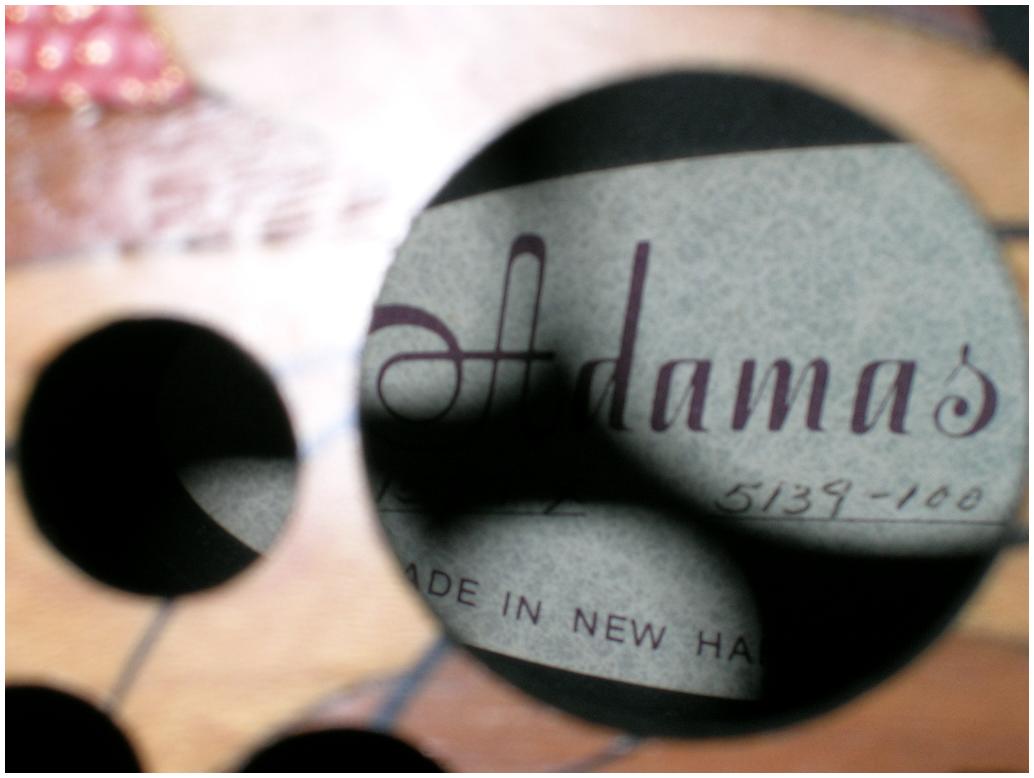 | ||
| |||
| Tony Calman |
| ||
Joined: August 2003 Posts: 4619 Location: SoCal | 1687-7, 1893-101 nice balance...great guitar | ||
| |||
| stonebobbo |
| ||
Joined: August 2002 Posts: 8307 Location: Tennessee | Very interesting indeed. My OFC Slothead #6 has EXACTLY the same FF as #5 that Dave posted above, but at a different db level. But there is a difference with the second "highest" point (is there a secondary FF?).  Now ... more interesting perhaps is that Alpep arranged to have Laser Vibrometer plots done on the OFC II guitars. If I understand this correctly, the FF of OFC II #3 is 202. But notice that the second highest plot is at 116, but the two points are relatively close in terms of the dbs.  What does this mean? Hell if I know. I'm hoping someone here can explain it. Obviously the guitars sound different, but based upon the plots, what should this tell us? | ||
| |||
| cholloway |
| ||
Joined: March 2005 Posts: 2793 Location: Atlanta, GA. | Also notice that OFC slothead #5 was plotted 12 minutes before #6. Hmmmm... Very curious indeed!!! | ||
| |||
| Paul Templeman |
| ||
Joined: February 2002 Posts: 5750 Location: Scotland | You are all referring to the number included in the serial number as the FF of the soundboard. It's not. It is the fundamental frequecy of the air cavity. | ||
| |||
| MWoody |
| ||
Joined: December 2003 Posts: 13997 Location: Upper Left USA | Damn that Heimholtz guy to heck! You mean I paid this much for another Air Guitar? M(Won the first pair of Air Guitars auctioned on Ebay)Woody | ||
| |||
| stonebobbo |
| ||
Joined: August 2002 Posts: 8307 Location: Tennessee | Originally posted by Paul Templeman: Thanks, Paul. That explains a lot. I assume the some of the differences we see (ie 83 for Jerome's and 101 for Tony's) is because of the preamp and the effect it has on the sound within the bowl? Changes through the evolution of the preamp and how their physical dimensions probably account for some variation through the years. Also figures that the shape of the bowl explains the significant(?) difference between a deep bowl and a deep contour bowl. But then again, the top HAS to come into play too, right? Because one of the things that has me confounded is that Todd's SSB would have a lower FF than a lot of deep bowl guitars. Or am I completed screwed up in my thinking? You are all referring to the number included in the serial number as the FF of the soundboard. It's not. It is the fundamental frequecy of the air cavity. There was an interesting discussion a couple of years ago when the OFC slotheads came out. The discussion moved to the original slotheads, and how the fundamental frequency (apparently) changed over 30 years or so. Laser Vibrometer Plots . Can anyone (Dr. Hemlholtz :) )explain the physics of how the fundamental frequency would vary on different guitars given the top movement (i.e. MIBs at 84 to mine at 93 when the guitars are ostensively nearly exactly the same)? Is it that the top moves in larger amount to make a lower FF? How exactly does the top vibration effect these various numbers? And then how does the second plot come into play, especially as the way it comes out on the OFC II? Sorry if this seems boring to you all. I just find it fascinating that you take take a piece of wood (even covered in carbon fiber) and make it sound like something other than a knock on a door. And all of the elements that can go into making all the different pieces of wood sound unique. | ||
| |||
| Todd G. |
| ||
Joined: September 2003 Posts: 815 Location: Colorado | But then again, the top HAS to come into play too, right? Because one of the things that has me confounded is that Todd's SSB would have a lower FF than a lot of deep bowl guitars. Or am I completed screwed up in my thinking? Concerning the above phenomenon, wouldn't the frequency being higher perhaps point to a more sensitive instrument and, maybe, higher (louder) acoustic output? Sort of like an audio speaker sensitivity rating--XX dB (output) @ XX watts (input), yes? In other words, the same input from guitar to guitar will yield output directly related to its FF. The higher the FF, the louder the guitar is acoustically. Or am I backwards and on the wrong path? | ||
| |||


| Jump to page : 1 Now viewing page 1 [25 messages per page] |
| Search this forum Printer friendly version E-mail a link to this thread |
| This message board and website is not sponsored or affiliated with Ovation® Guitars in any way. | |
| (Delete all cookies set by this site) | |